

French student convicted of vandalising Robert Badinter's grave
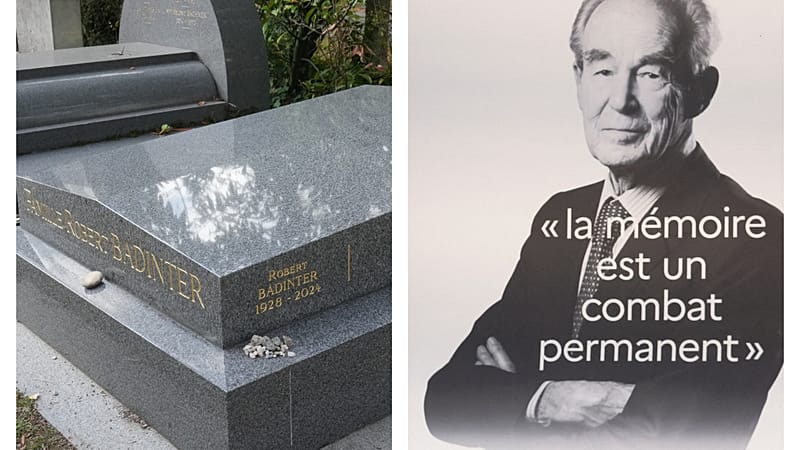
A French student has been convicted of vandalising the grave of Robert Badinter, the former justice minister who abolished the death penalty in France, just hours before the late statesman was to be honoured at the Panthéon.
The 23-year-old with no prior record was arrested on Tuesday morning and tried for grave desecration and property damage. He admitted to the offences and was sentenced to a one-year suspended jail term.
Police identified him through CCTV footage showing him entering and leaving Bagneux cemetery in the Hauts-de-Seine department on the night of 8 October 2025, as well as mobile phone data analysis. Investigators said he had located Badinter's grave several days earlier.
At trial, he described himself as a "royalist" who reacted to an incident where an unknown suspect damaged the tombstone of late far-right leader Jean-Marie Le Pen — a Holocaust denier — in January.
He spray-painted the following message on the former minister's tombstone: "Eternal is their recognition, murderers, paedos, rapists, the Republic sanctifies it".
Once the desecration was discovered on 9 October, France's political class united in condemning the act.
President Emmanuel Macron responded on social media platform X, stating: "Shame on those who sought to tarnish his memory. This evening, he will enter the Panthéon, the eternal home of conscience and justice. The Republic is always stronger than hatred."
Marie-Hélène Amiable, the mayor of Bagneux where Badinter is buried, condemned the "cowardly act" and said the inscriptions targeted his commitments against the death penalty and in favour of the decriminalisation of homosexuality.
Who was Robert Badinter?
Badinter, a lawyer and later justice minister, is remembered above all for his relentless campaign against capital punishment. He abolished the death penalty in 1981 following a historic speech to the National Assembly in which he argued forcefully for "justice that does not kill".
The landmark act made France one of the first European countries to permanently abandon capital punishment.
Born in Paris in 1928 to a Jewish family, Badinter experienced the horrors of World War II and France's collaboration first-hand, surviving the Holocaust under a false name. His father died in the Sobibor death camp. As a lawyer, he later pursued a notorious Holocaust denier in court.
It was also under Badinter's watch that France decriminalised homosexuality in 1982.
Badinter's advocacy against capital punishment intensified after 1972, when he failed to save his client Roger Bontems from the guillotine. Five years later, he convinced a jury not to execute Patrick Henry for the murder of a seven-year-old boy, becoming an instantly controversial figure among the French public.
As justice minister under President François Mitterrand, Badinter overcame public opposition and won parliamentary support for abolishing the death penalty in 1981. The last person executed in France was Hamida Djandoubi in 1977.
Badinter later served as president of the Constitutional Council and as a senator for 16 years.
The Panthéon ceremony
The pantheonisation ceremony — France's highest honour, which sees distinguished figures interred at the Panthéon monument in Paris — took place on the evening of 9 October, hours after the vandalism was discovered.
However, Badinter's body remains in the Jewish section of Bagneux cemetery. A cenotaph containing his lawyer's gown, three cherished books and a copy of his most famous speech was placed in the Panthéon instead.
His widow, Elisabeth Badinter, explained the couple wanted to remain together after death: "What we wanted was not to be separated."
Badinter joined other French luminaries honoured at the site, including philosopher Voltaire, scientist Marie Curie, writer Victor Hugo and French Resistance hero Jean Moulin.
Today