

‘I’m free’: How VR therapy helped a schizophrenia patient silence 27 years of voices
For 27 years, Vibeke Andersen heard voices telling her she was worthless.
The 53-year-old was diagnosed with paranoid schizophrenia and heard voices for 27 years, which had her repeatedly going in and out of psychiatric hospitals. The voices controlled what she said and did, and sometimes told her that even her family could not love her.
“They told me that I was not worth living as a human being. Nobody cared about me,” Andersen told Euronews Health.
Then, in 2020, she was offered an experimental treatment that asked her to do something that might seem counterintuitive. Instead of trying to distance herself from the voice, she would confront a virtual version of it face-to-face.
Confronting symptoms inside virtual reality
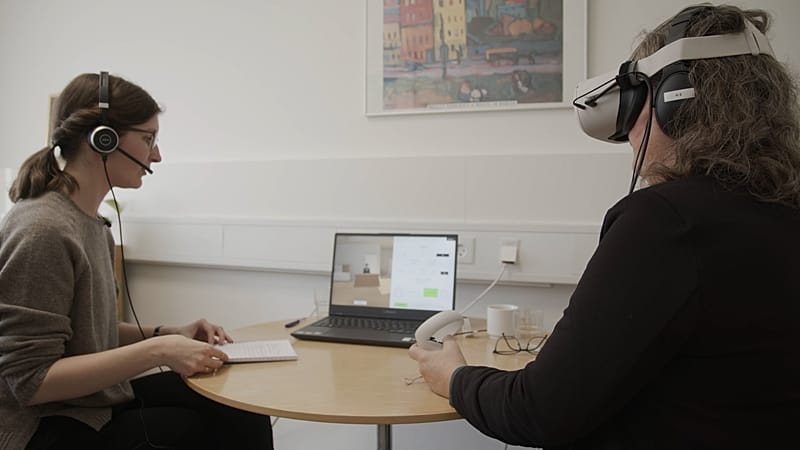
Therapists working with the VIRTU research team used specialised software to create an avatar based on Andersen’s description of the dominant voice she heard, adjusting its appearance and sound until it resembled her experience.
Once Andersen put on a virtual reality (VR) headset, the avatar appeared in front of her while her therapist repeated the kinds of things Andersen normally heard, using voice-transformation software to make the voice sound similar.
“They engage in this conversation, talking back and forth, standing up against the voice, reclaiming the power and control over it,” Louise Birkedal Glenthøj, head of the VIRTU research group and associate professor at the department of psychology at the University of Copenhagen, told Euronews Health.
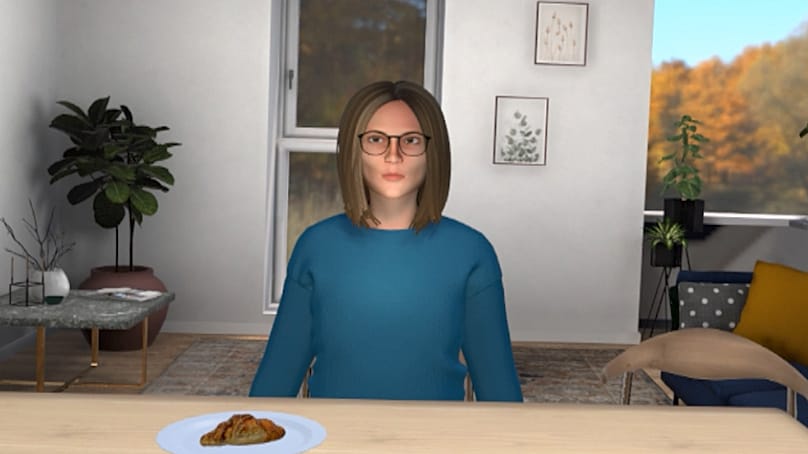
The process became so difficult that around her fourth or fifth session her therapists considered ending the treatment.
“They told me that I better drop off this treatment,” Andersen said. “I was still stubborn and I thought, ‘No way. I'm going to do this treatment to the end.
Towards the end of the intervention, Andersen went into a forest and began screaming at the voice.
“F**k off,” she remembers shouting. “I don't want these voices anymore. They had to get out of my life. They had to leave me, leave my mind, and I had to be free as a person.”
A ‘safe and tolerable’ treatment
Andersen was part of the CHALLENGE project led by doctors and scientists at the VIRTU Research Group at Copenhagen University Hospital’s mental health services.
The trial included 270 people with schizophrenia-spectrum disorders and persistent auditory hallucinations. Those assigned to the VR therapy received seven sessions, while the comparison group received standard care with additional supportive counselling.
The results of the study, published in The Lancet Psychiatry in 2025, found that VR therapy significantly reduced the overall severity of auditory hallucinations after 12 weeks compared with the control group, while patients also heard voices less frequently at both 12 and 24 weeks.
“We were very surprised. This was a very experimental study. Could it actually work? Was it feasible? What would the patients think of going into this simulated reality and confronting their symptoms?” Glenthøj said.
The wider VIRTU research programme now involves around 1,000 participants across studies of several mental health disorders, and some of its VR treatments are now being used in Denmark’s psychiatric services, according to Glenthøj.
The conditions covered by the research affect millions of people worldwide. Schizophrenia affects around 23 million people and eating disorders around 16 million, while anxiety disorders affect about 359 million. Around one in 127 people globally are autistic, according to the World Health Organization.
“What is very rewarding now is to see that we can actually achieve quite a change by very short-term interventions,” Glenthøj said.
While participants in the trial received a set number of sessions so researchers could compare the results, Glenthøj said the treatment can be more flexible when offered to patients outside a research trial, depending on how much preparation and therapy an individual needs.
The confrontational approach may also not be suitable for everyone.
“For some, it is very overwhelming,” Glenthøj said. “You might experience a deterioration or increasing symptoms for a period, but that will pass, and then you will hopefully have greater control over the symptoms.”
“We try to adjust individually also how we pace the therapy in terms of the anxiety response,” she added, saying some patients may need other therapy or more preparation before starting. Overall, she said their research has found the treatment to be “safe and tolerable”.
Researchers are still trying to understand exactly why confronting a simulated voice can have such an effect. One hypothesis is that turning something experienced only inside the patient’s head into something they can see, hear and respond to gives them greater control over it, a process researchers describe as ‘externalisation’.
“With VR, we can kind of bridge patients’ daily life and therapy,” Glenthøj said. “We can bring daily life into the therapy room.”
VIRTU is now studying VR across psychosis, eating disorders, social anxiety, autism and depression, adapting the virtual experience to different symptoms.
For people with eating disorders, for example, an avatar can represent the critical “eating disorder voice” some patients experience, while other projects recreate social situations to work with paranoia or anxiety.
When the voice disappeared
By the time Andersen arrived for what would have been her final session, the voice had disappeared.
“I came to my last treatment after Christmas and I said, ‘I don't have to say goodbye to something which is not there’. So I left the session. I said, ‘I think I'm cured’,” Andersen said.
At a six-month follow-up, she was still not hearing voices, and five years later she says they have not returned.
“I'm free. I'm living my life as I always have dreamt of,” Andersen said.
Since then, she says she has started studying to become a social worker.
“I felt some meaning in my life for the first time in my life. I was a human being. I was just not a number in a system. I was not seen as a diagnosis, a paranoid schizophrenia,” Andersen said.
The next step is AI
Glenthøj said one goal is to incorporate artificial intelligence (AI) into some of the interventions.
“We can't give therapy to all these patients that actually need it,” Glenthøj said. “So if we can use AI safely and ethically for some of these purposes, that would be very helpful.”
One idea is to develop an AI-supported virtual therapist that patients could access outside the clinic.
After completing face-to-face treatment, they might use an app at home to practise coping strategies, reinforce what they learned in therapy and remind themselves how to respond when symptoms return.
The group is also experimenting with generative AI in the construction of virtual environments. Patients can describe a scenario from their past and researchers use text-to-image AI tools to help recreate aspects of it in VR.
But Glenthøj stresses that using AI with people experiencing severe psychiatric symptoms will require careful clinical and ethical safeguards.
For more on this story, watch the video in the media player above.
Today