

Can electric air taxis really ease city gridlock? Vertical Aerospace reveals latest flying taxi
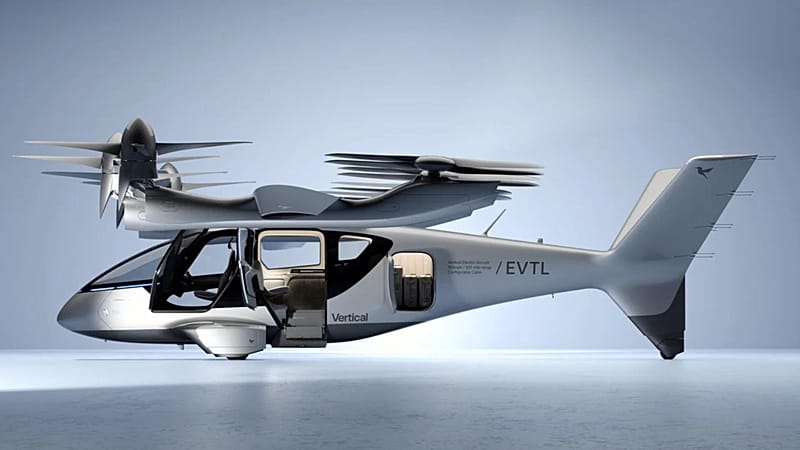
British aircraft maker Vertical Aerospace has revealed its latest attempt to reimagine short-haul travel: a production-version electric air taxi called the Valo.
The company describes it as a step towards "urban air mobility for the masses," though the reality of such ambitions remains hotly debated.
Electric vertical take-off and landing aircraft, or eVTOLs, have long been pitched as a cleaner, quieter alternative to helicopters - a way to sidestep gridlocked cities by simply lifting above them.
But the question of whether there is a viable mass market still divides the industry.
Unlocking the "third dimension"
The Valo, unveiled on 10 December, is the successor to Vertical’s VX4 prototype. The model shown to journalists was a fully fitted mock-up: a glossy four-seat cabin marketed as the “luxury” option, though the company says a six-passenger configuration is also planned.
David King, the firm’s chief engineer, frames the project as an answer to urban congestion.
"So our mission at Vertical Aerospace is to deliver electric vertical take-off and landing to the masses. To provide point-to-point transportation," he said.
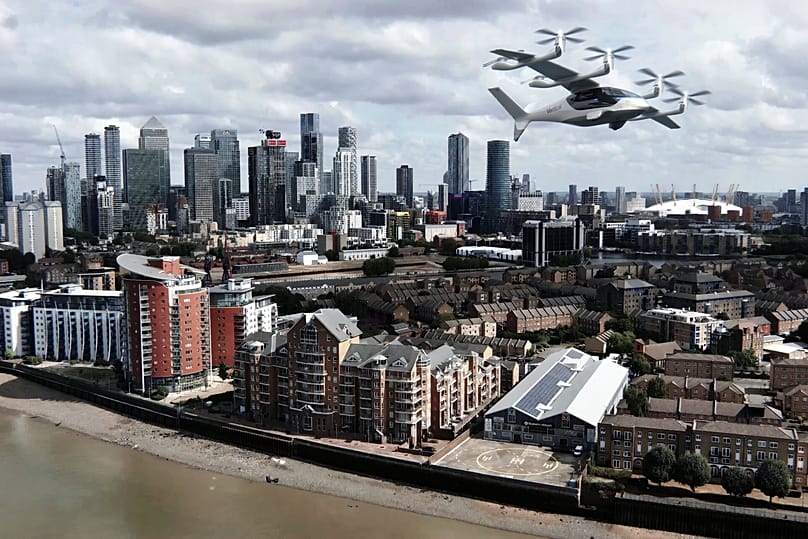
It is targeting a top speed of around 150 mph and a range of 100 miles - enough, the company argues, to make airport transfers and short inter-city hops feasible.
King argues that mobility has stagnated while other technologies have accelerated. "One thing is now slower than it was ten years ago, 30 years ago, 50 years ago, and that's mobility," he said. His pitch is simple: unlock a "third dimension" of urban travel.
The cabin has been designed with airport travellers in mind, including space for six cabin bags and six checked bags.
Test pilot Simon Davies, who has spent much of 2025 flying the VX4, says the aircraft is far easier to master than a helicopter. "Really [it] is super simple. You push forward on this lever. It makes you go forward. You pull back on the control stick. It makes you go up… And the aircraft works out how to make it all happen for you," he said, sitting in the cockpit.
Vertical says it has roughly 1,500 pre-orders from operators including major airlines such as American Airlines, though none are binding.
Analysts question the economics
Yet not everyone is convinced that eVTOLs are the dawn of affordable urban aviation. Richard Aboulafia, managing director at AeroDynamic Advisory, cautions that the basic economics of vertical flight have not changed.
"You know I want to live in a world where I can fly helicopters everywhere… Unfortunately, the economics of flying vertically have been about the same for a really long time,” he said.
"While Vertical has produced an interesting machine… the economics are about the same, maybe a little worse - we don't know - than flying in a helicopter."
Vertical claims eventual fares could be comparable to an Uber from Canary Wharf to Heathrow. Aboulafia disagrees. He estimates the aircraft’s price at $4 to $5 million (€3.4 to €4.4 million) - a figure Vertical would not confirm, but described as "in the ballpark" - and believes the sector risks "a recipe for mass bankruptcies, economic carnage."
Today