

The EU wants to end the era of national vetoes – but it's complicated
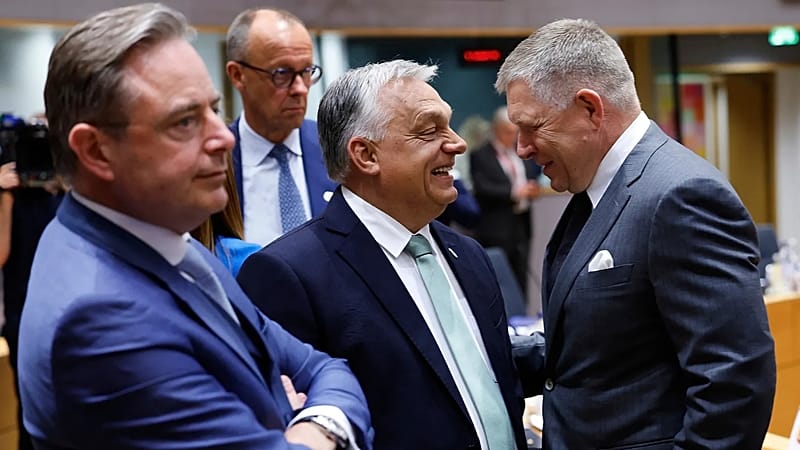
At a crunch summit earlier this month, European leaders turned to a tool that would have seemed unthinkable just a few months earlier to break an impasse: issuing joint debt backed by the common budget to keep Ukraine afloat as the war rages on.
The trick? It bypassed the need for unanimity among member states, gathering those who wanted to work together while keeping Hungary, Slovakia and the Czech Republic out of the deal as a condition for it to go forward. In doing so, the EU not only managed to secure €90 billion for Ukraine for 2026 and 2027 as it had promised, but also showed a new path forward – one where where the unanimity requirement need no longer obstruct coalitions of the willing.
That is nothing short of extraordinary for a union often constrained by unanimous decision-making. It also builds a theme that is gaining momentum in Brussels: finding alternatives to bypass national vetoes, in particular when exercised by Hungary, which has made its right to veto the centrepiece of its Brussels policy when it comes to Ukraine - from its financing to Kyiv's candidacy to join the EU.
To issue joint debt at 24, bypassing Budapest, Prague and Bratislava, the EU cited the principle of "enhanced cooperation" as foreseen in its treaties. It is just the latest legal tweak that Brussels has turned to in order to break a deadlock.
Most recently, it also employed Article 122 of the treaties, approved through qualified majority, to keep the Russian frozen assets held in Europe locked indefinitely in the EU. Until then, the assets had been held under a standard sanction regime, which operated on unanimity and therefore depended on securing a yes from Hungary and Slovakia.
While Article 122 is framed in the treaties as a means by which to address severe economic crises, the plan to use it to unlock funding for Ukraine was clearly a way to bypass recalcitrant member states. It's another example of a strategy the bloc is increasingly using to circumvent vetoes on issues where a near-consensus exists, an approach that is starting to yield results – but not without risks.
“We see straightforward commitment from the part of EU leadership to try to circumvent potential vetoes coming from Hungary and Slovakia and put important decisions on the footing of qualified majority voting," Dániel Hegedűs, a regional director of the German Marshall Fund, told Euronews.
"On the other hand, I don't think that this is bulletproof. Neither legally nor politically.”
The Hungary problem
According to a list compiled by University College London lecturer Michal Ovádek, since 2011, a total of 46 vetoes have been exercised in the EU by 15 member states across 38 issues. Hungary vetoed EU proposals more than any other member state in recent history, with a total of 19.
Poland ranks second with seven vetoes, while Slovakia, which has also been frequently in the headlines across Europe for the controversial decisions of Prime Minister Robert Fico, has blocked two decisions, both of them this year.
Hungary has vetoed a significant number of joint foreign policy statements, but it has also blocked proposals to lend concrete support to Ukraine and start formal EU accession talks with Kyiv.
The result is that most EU statements supporting Ukraine have been issued in the name of the EU-26, excluding Hungary. This does not change the fact that all member states can veto decisions requiring unanimity for major policy changes.
Mikuláš Dzurinda, the chair of the Martens Centre think tank and former prime minister of Slovakia, told Euronews that leaders like German Chancellor Friedrich Merz and French President Emmanuel Macron now support changes to the bloc's voting rules.
But any such move would require a treaty change, which would itself probably be resisted by Hungary – and potentially other member states too. Yet since the systematic use of the veto power has posed a problem for the EU for years, Brussels is now looking for more creative solutions.
Policy designed to bypass vetoes
An EU diplomat, who spoke to Euronews on condition of anonymity, said that the European Commission is now deliberately structuring its proposals in order to avoid requiring unanimous consent from member states.
One attempt to bypass the likely veto from Slovakia and Hungary came in May this year with the presentation of the REpowerEU roadmap, a package designed to phase out Russian fossil fuel imports by 2027.
In 2022, the EU imposed sanctions on Russian oil imports following Moscow's full-scale invasion of Ukraine, but Hungary and Slovakia received exemptions. This time, the European Commission has decided to phase out Russian fuels altogether despite the opposition of Budapest and Bratislava.
To do this, the bloc has opted for a veto-proof strategy: the roadmap itself is not legally binding, but the legislation on cutting oil and gas imports will be adopted by a qualified majority at the European Council. Hungary and Slovakia will thus be obliged to drop Russian gas against their will.
Both countries have already signalled that they will sue the EU and ask for the measure to be annulled.
"This is not the first time the EU has reclassified measures that could not gain enough support to be designated as sanctions," international law expert Tamás Lattmann said.
“This has been on the agenda for years: if measures can not be imposed on Russian raw material procurement with sanctions regimes lacking the consensus, they can be reclassified as foreign trade or something else, and it becomes an EU competence," Lattmann told the podcast Pirkadat.
A multi-speed bloc
A source at the European Commission told Euronews that Europe could also bypass opposition from member states by adopting a model similar to the Coalition of the Willing, a group of like-minded countries willing to support Ukraine.
Former European Central Bank President Mario Draghi, a highly influential voice in the European debate, has spoken in favour of this model, calling it "pragmatic federalism" as the political conditions for a true, federal union do not exist in the EU at the moment.
The EU has seen many examples of how like-minded countries can advance together through voluntary co-operation, among them the Schengen project and various initiatives in migration and finance. This method is politically the most acceptable option for the bloc's more reluctant countries, and the EU is already operating as a multi-speed organisation.
The Coalition of the Willing model can also be applied to matters beyond Ukraine, extending to defence and finance. The head of the International Monetary Fund, Kristalina Georgieva, also spoke in favour of it in an interview with Euronews, referring to it as a useful format when unanimity cannot be reached despite good faith efforts.
Enlarging the European Union
One area where qualified majority could play a decisive role is EU enlargement.
Unanimity is always required to approve the start of accession talks and to open each negotiating chapter. At the December 2023 summit, Orbán famously lifted his veto on Ukraine’s accession talks after leaving the leaders' room for a break, while the other member states approved the move. But since then, he has been blocking the opening of negotiating chapters, hindering the accession talks.
Earlier this year, European Council President António Costa proposed amending the enlargement rules to expedite the process, eliminating the unanimous decision required for each chapter.
But the changes would have required a treaty change, and the Hungarian premier quickly dismissed the idea at the Copenhagen informal summit in October.
Right now, the EU is accelerating technical work on negotiating chapters, aiming to have most of the work completed once political approval is granted.
Enlargement Commissioner Marta Kos told Euronews at the flagship EU summit that Ukraine is "technically ready" to open up the clusters and that the bloc should get creative in finding a solution for it. But as it stands, unless rules are changed or Orbán can be convinced, Kyiv's bid to move closer to the EU would be stuck in limbo.
The risks of a permanent bypass
Yet some experts warn that bypassing opposing member states in numerous different areas could backfire on the EU.
Hungary and Slovakia have already signalled that they will challenge the phase-out of Russian fuels under the REPowerEU framework once the legislation is approved. The Commission faces the same risks over using Article 122 to extend the freeze on the Russian assets; according to Hegedűs, Hungary has a chance of winning those files.
“Of course, we know that a ruling can be expected in 18 to 24 months, and practically, we need to survive the next couple of months," Hegedűs said. "So, it's a long-term problem, it's practically kicking the can down the road."
Still, bypassing unanimity may present other problems. And it is not clear that all member states would like to see the power of the veto eroded over time, since it is often seen as the last resort to protect national interests.
All member states have at some point threatened to use their veto at the Council. It also serves as an equaliser between smaller and larger member states, as it ensures that members of any given size hold equal power around the negotiating table.
"A veto power is the last line of defence of vital interests," Lattmann said. "Every case of circumvention has led to a set of new problems, often the inoperability or discrediting of the system itself."
With additional reporting from Maria Tadeo
Today