

This tiny robot could help deliver drugs, dissolve blood clots and detect cancer
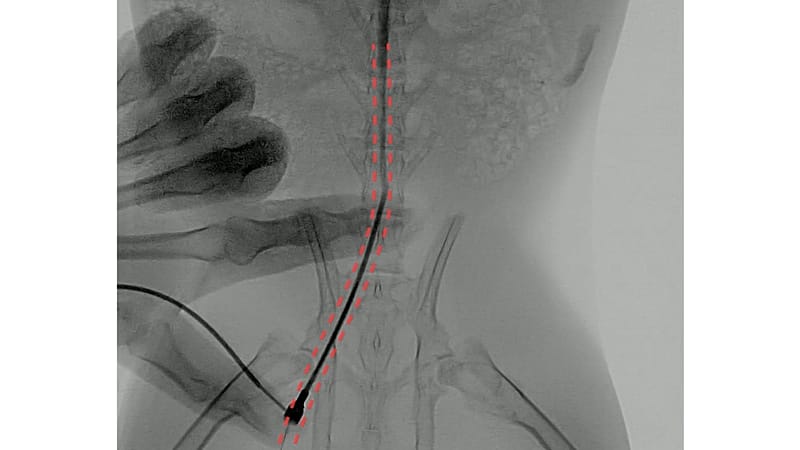
Scientists have developed a tiny soft robot covered in hair-like structures that can manipulate the flow of blood, potentially helping drugs reach vessel walls, speeding up the breakdown of blood clots and capturing rare cancer cells.
Researchers from the Shenzhen Institute of Artificial Intelligence and Robotics for Society, The Chinese University of Hong Kong, and Chinese PLA General Hospital in China developed a device called CiliaVine, which could eventually help deliver drugs more precisely, treat blood clots and potentially help monitor cancer by capturing tumour cells circulating in the bloodstream.
It is attached to a medical guidewire and uses magnetic fields to make tiny flexible hair-like structures, known as cilia, move in different patterns.
In the study, researchers tested its ability to break down clots and deliver drugs in laboratory models, and to capture tumour cells from liver cancer patients’ blood samples and inside rabbits with liver tumours.
Blood normally flows through vessels in smooth layers. While this is efficient for circulation, it makes it difficult to move drugs, particles or cells sideways across the bloodstream.
Researchers designed the robot to disrupt that flow locally. Depending on how the magnetic field is programmed, its cilia can pump material towards the vessel wall, draw material away from it or create tiny vortices that mix the surrounding fluid.
In laboratory tests, the robot helped deliver a greater amount of a model drug towards the vessel wall.
The total reaching the wall was 146% higher than when the drug was left to spread naturally, while 75% more reached 1 mm beyond the vessel wall.
Researchers also tested whether the robot could help dissolve blood clots. In a vessel model treated with the clot-busting drug tPA, clots were dissolved in around 40 minutes when the robot was operating, compared with an average of 70 minutes without it.
The tiny robot can also be used for cancer monitoring, according to the study. By coating the robot with antibodies, researchers captured circulating tumour cells, rare cancer cells released into the bloodstream, in samples from all 23 liver cancer patients tested at the Chinese PLA General Hospital in China.
The team also tested the robot inside living rabbits with liver tumours, where it was inserted into a major vein through a catheter and operated magnetically for 20 minutes with no reported signs of inflammation or tissue damage in the examined vessel sections.
The technology has not yet been tested as a treatment or diagnostic tool inside human patients. But researchers say it could eventually offer a way to manipulate drugs and cells directly inside specific parts of the bloodstream, rather than relying on blood flow alone to carry them to their destination.
Today