

Portugal's pension surplus is an illusion, new report warns

Portugal's social security system looks healthy on paper. A new report says that is an illusion, and pensions are set to shrink in the years ahead.
Those are two of the central warnings in "Reforming Pensions in Portugal: For a Sustainable and Fair System — A Contract Between Generations", a report drawn up by a working group led by economist and professor Jorge Bravo.
The report puts the real social security deficit at almost €1.94 billion in 2025, once the accounts of the Caixa Geral de Aposentações, the public body responsible for civil servants' pensions, are combined with the general regime.
Looked at in isolation, the official accounts instead show a surplus, which the report's authors argue is misleading.
They put that apparent surplus down to factors including the gradual shift of CGA contributors onto the general regime and rising immigration, which has boosted the number of people paying into the system.
Bravo also warned of a steady decline in the replacement rate, the share of a worker's final salary that their first pension payment covers. That currently stands at around 68% but is projected to fall by 10 to 12 percentage points between 2045 and 2065.
Bravo stated that he wants "to leave better protection conditions for future generations," and the working group has put forward a number of proposals with that in mind.
Bárbara Barroso, a personal finance expert and founder of MoneyLab, sees it as "extremely positive" that this issue is on the agenda, even if she does not agree with some of the proposals.
"I think it is good that we are bringing this topic into the spotlight because the sustainability of our retirement income, of pensions, is a real problem and one we need to solve before it is too late," Barroso said.
José Santiago Gavino, a personal finance expert at Sixty Degrees, noted that some of these proposals already exist abroad.
"I think the intention was to look for examples from other countries and put forward what they felt made most sense," Gavino explains.

Savings accounts for children and young people
One of the proposals listed in the report on pension reform is called the "Grão a Grão" or "Grain by Grain" programme, an automatically opened savings account for all children living in the country.
The account would receive a token monthly contribution from the state, which relatives could top up with other savings, cash gifts or the child benefit payment. The money could only be used at retirement age, although it could be pledged as collateral, for example for a student loan.
"Obviously, the earlier you start saving, the better, because time then works in our favour," argued Barroso, adding however that some fundamental aspects of the proposal still need to be clarified and that it should not simply be a savings account.
"We have to swap savings for investment. We have to stop being a country of savers and become a country of investors," she said. "Thinking that things are solved with this kind of low-risk saving – they are not, full stop. You cannot solve long-term saving without taking on risk and without embracing the capital markets."
José Santiago Gavino took the same view.
"It always makes sense if it follows the logic of an investment with some risk. Having a term deposit at 1% is still better than saving nothing at all… But it seems to me that the investment should be looked at more from a long-term perspective," said the personal finance expert.
"It has been proven over the last 100 years that taking on some risk has always been much more profitable," he added.
Mandatory auto-enrolment supplementary schemes
Another proposal is a supplementary scheme with automatic enrolment, with an opt-out option. The plan would be triggered when an employment contract begins, with contributions from the worker, the company and the state, totalling between 8% and 10% of salary.
Bárbara Barroso says that "automatic enrolment is probably the proposal with the greatest potential to increase retirement saving".
"People are automatically enrolled in a plan, they retain the freedom to leave and it helps them overcome inertia," she stated. "It helps overcome inertia and that tendency to put off very important decisions."
José Santiago Gavino notes that in Portugal some companies already have this kind of scheme, which can then provide a top-up to the state pension as one of the three pillars of the pension system.
"In other words, the first pillar is our standard state pension, the second pillar is this mixed model and the third is what each person saves on their own. And this auto-enrollment pillar would be the second pillar. Several countries already have it and I think it would make sense," he explained.
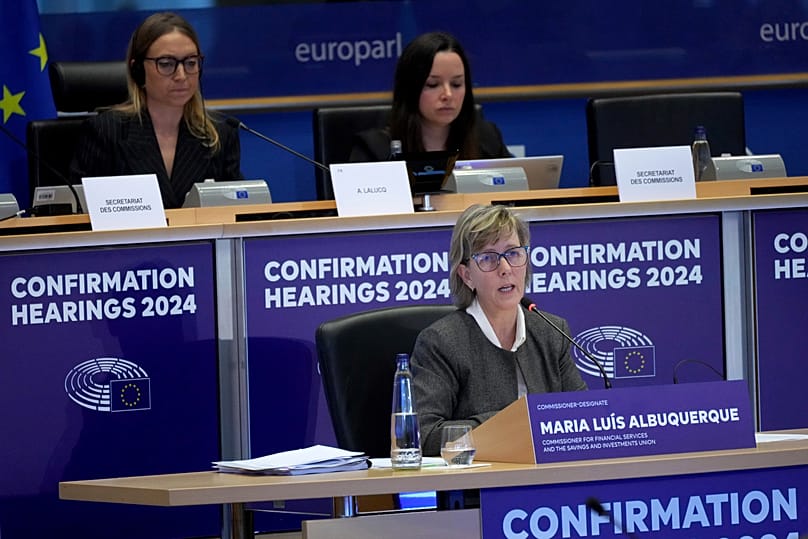
The creation of a similar system is advocated by the European Commission. It is part of a package presented in November by the Commissioner for Financial Services, Maria Luís Albuquerque, who also happens to be Portuguese.
Savings Certificates for retirement
The working group is also proposing the creation of new government debt securities, such as Savings Certificates or Treasury Certificates, but specifically geared towards retirement. In this case, repayment could take place over a period of time instead of all at once.
"It would be a more conservative investment for those already close to retirement, for those five years away from retirement, or those ten years away," comments José Santiago Gavino.
"But for those who are 20 or 30 years away, it does not seem to me to be the most interesting investment," he adds, noting that, even so, Savings Certificates can be used alongside other investments.
By contrast, Bárbara Barroso does not see "any need here for more savings instruments". She considers that Savings Certificates are suitable for conservative profiles, but should not "necessarily represent all retirement savings".
"It is important to understand that when we buy government debt, we are lending directly to the state. So the money is not invested in a diversified portfolio; it is concentrated in Portuguese sovereign risk," she explains.
Getting ready for retirement without waiting for new measures
In reaction to the announcement of the report’s contents, a source in the Portuguese government told the newspaper Público that this administration does not intend to carry out structural reforms of Social Security.
This is despite the fact that it was the government itself that commissioned the study, which was handed to the responsible minister, Maria do Rosário Palma Ramalho, at the end of July.
Even so, the two personal finance experts interviewed by Euronews argue that taxpayers should independently move ahead with complementary pension plans, on top of social security.
"Not from a financial point of view but from a more practical point of view, it is very easy to save," Gavino noted.
"Many banks allow saving from one euro. Now, with all the phone apps, it is also possible to automate investment, even in shares or in higher-risk funds, starting from one euro, two euros, 25 euros," he adds, recalling a time when investing required a lot of red tape and a certain amount of capital.
Today, says the consultant, it is possible "to start doing it early on and not necessarily with very large amounts", stressing the importance of compound interest.
Bárbara Barroso admits that the country has a low-wage problem, where the priority is often putting food on the table. But the MoneyLab founder says there are people who could invest and still do not do so.
"Not everyone earns the minimum wage. It is one fifth of the working population that earns the minimum wage," she said. "And there are people who are able to save 50 euros a month and invest, and they do not invest. Most of the money, more than 200 billion, is parked in deposits that do not even match inflation."
"So for those who have that financial capacity, clearly, in my view, they should not wait for new measures. They should start working on their own retirement top-up right now," she warned.
Today